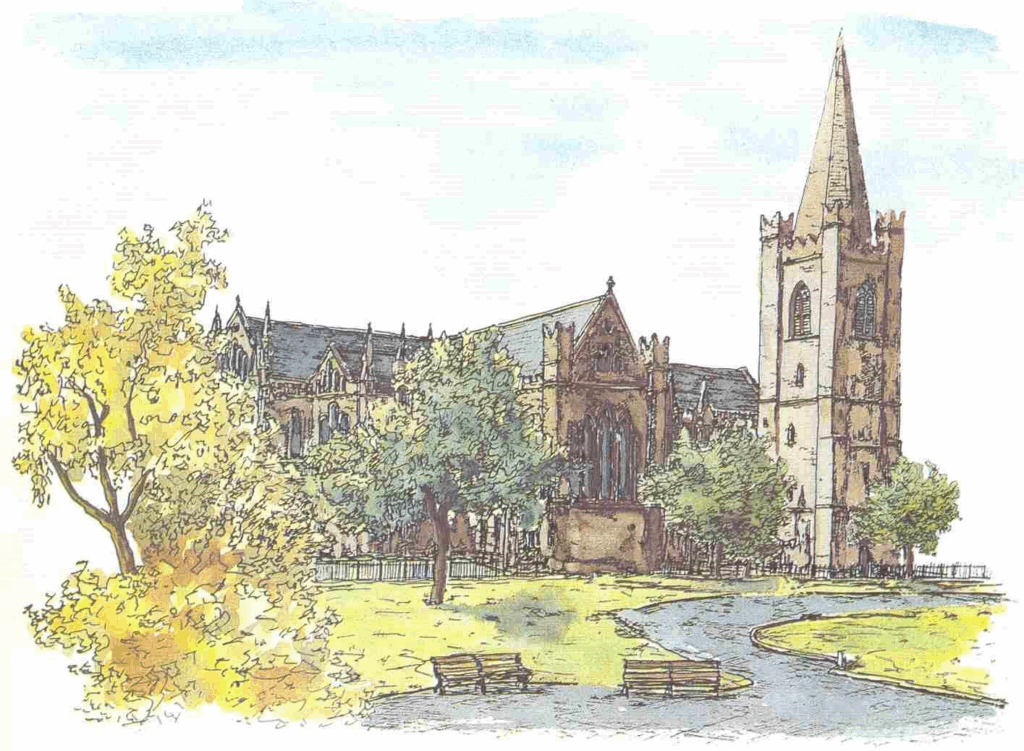
The first Norman Archbishop of Dublin (elected 1181), John Comyn, a Benedictine monk, wanted to remove himself from the Augustinian-controlled Christ Church Cathedral and from the confines and laws of the city. He moved his residence to St Sepulchre’s Palace in the south suburbs beside the site of the old wooden St Patrick’s church. Comyn replaced this old Celtic church with a stone one in 1191. At first the new St Patrick’s, situated on an island between two streams of the Poddle River (now underground) was elevated to the status of a collegiate church (first step to becoming a cathedral). In 1213 Comyn’s ambition was realised posthumously when St Patrick’s was elevated to cathedral status under his successor (from 1212), Henry of London. From 1225 the cathedral was refashioned in the style that we see today. The design of the central part of the church is an almost exact copy of the first Salisbury Cathedral, which was being built at the same time.
Ireland’s first university was founded at St. Patrick’s (possibly at St Sepulchre) in 1320 and intermittently operated for 200 years. The cathedral’s most famous dean was Jonathan Swift (1667-1745), creator of Gulliver’s Travels and indefatigable champion of the underprivileged. He is now buried under the cathedral, along with his beloved Stella (Esther Johnson).