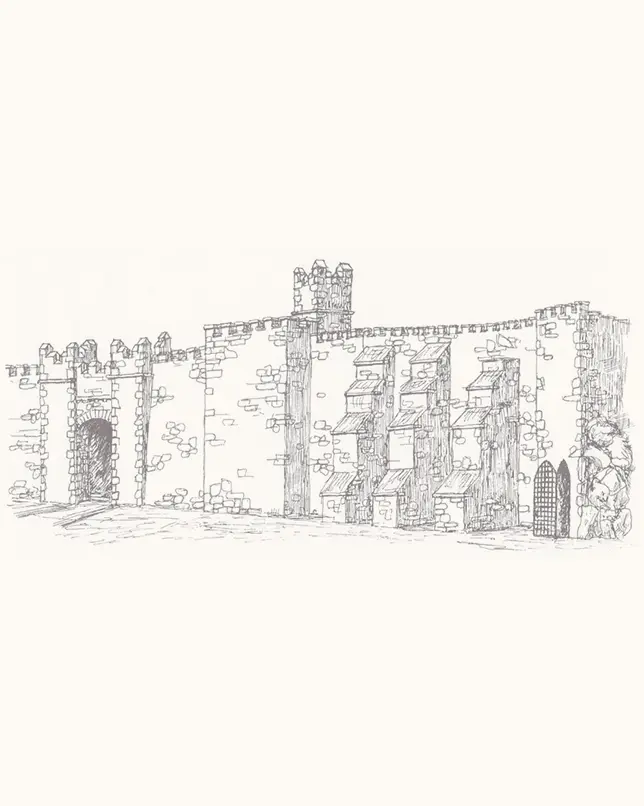
At the bottom of the only natural hill in the centre of Dublin the Vikings built the Cook Street section of their first defensive wall around their fledgling town. Initially only a wooden wall erected on a rampart of clay, by the end of the 11th century an imposing wall of stone was erected. The location was close to the then riverbank of a much wider River Liffey at high tide.
During the thirteenth century the English settlers, who had ousted the Vikings in 1170, gradually reclaimed land from the Liffey so as to obtain a deeper berthage for merchant ships and a new wall was built further north along today’s Merchants Quay. No trace of this later wall now remains above ground. A number of gateways were cut through the old Viking wall to give access to the available new quarter and of these the sole survivor is St. Audoen’s Arch (c. 1240 or earlier).
This stretch of wall along Cook Street was preserved simply because houses were built right up to it and it was forgotten until rediscovered in the 19th century. St Audoen’s Gate is named after St Ouen the patron saint of Normandy (and the Normans who first took Dublin from the Vikings) and after whom the capital of Normandy, Rouen, is named. Ouen, over time, became Audoen.
Cook Street was so named because in medieval cities certain trades were assembled outside the city walls (in this case between old walls and newer walls) to prevent the danger of fire because most buildings were made from highly inflammable wood. Cooks, bakers and blacksmiths were good examples of these trades. Other areas in Dublin still have names which describe the ancient trades carried on certain streets there including Haymarket, Cornmarket, Winetavern Street, Fishamble Street and so forth.