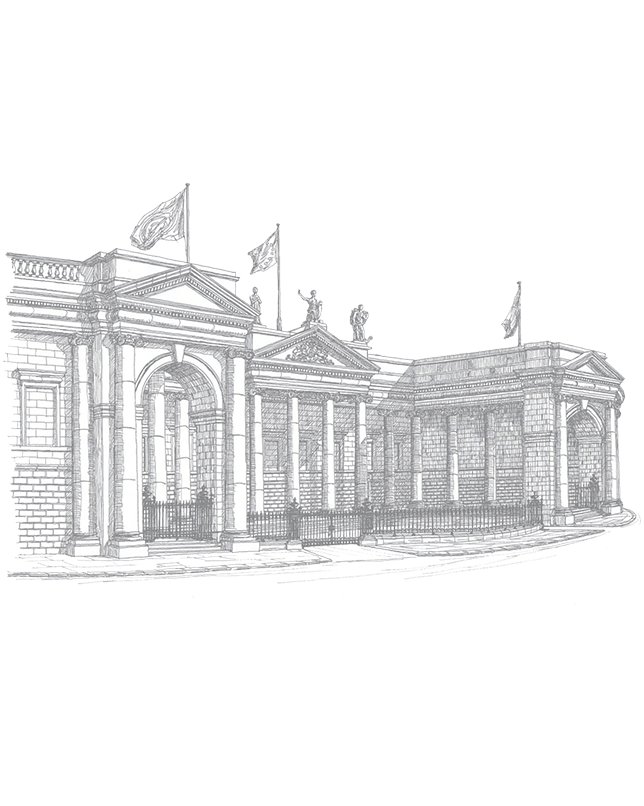
Because of its flat and enclosed situation, it is hard to take in the full grandeur of the Bank of Ireland building on College Green. Ideally, it would have to be set on a hill, separated from other buildings, to appreciate the sweeping, curving magnificence of the complex. Built in 1729, as the world’s first edifice to house a two-house parliament, it would occupy the talents of four famous architects for the next 75 years; Edward Lovett Pearce (the central section), James Gandon (the east portico in 1785), Robert Parke (the Foster Place portico in 1797) and Francis Johnston (the curving wall and the armoury annexe in Foster Place in 1803).
Initially, the Irish Parliament passed laws that were subject to the approval of the English Parliament, but gradually, during the latter half of the 18th century, it began to become more independent. Fearing this independence, the British, through bribery, corruption, and threat, basically forced the Irish Parliament to vote itself out of existence and ceased to exist by 1800. On the 1st of January 1801, Ireland lost its colony status and was absorbed into communion with Britain as part of the new United Kingdom.
The empty Irish Parliament building then became the headquarters of the Bank of Ireland in 1803. The former House of Lords chamber has been preserved and can be visited when open to the public.