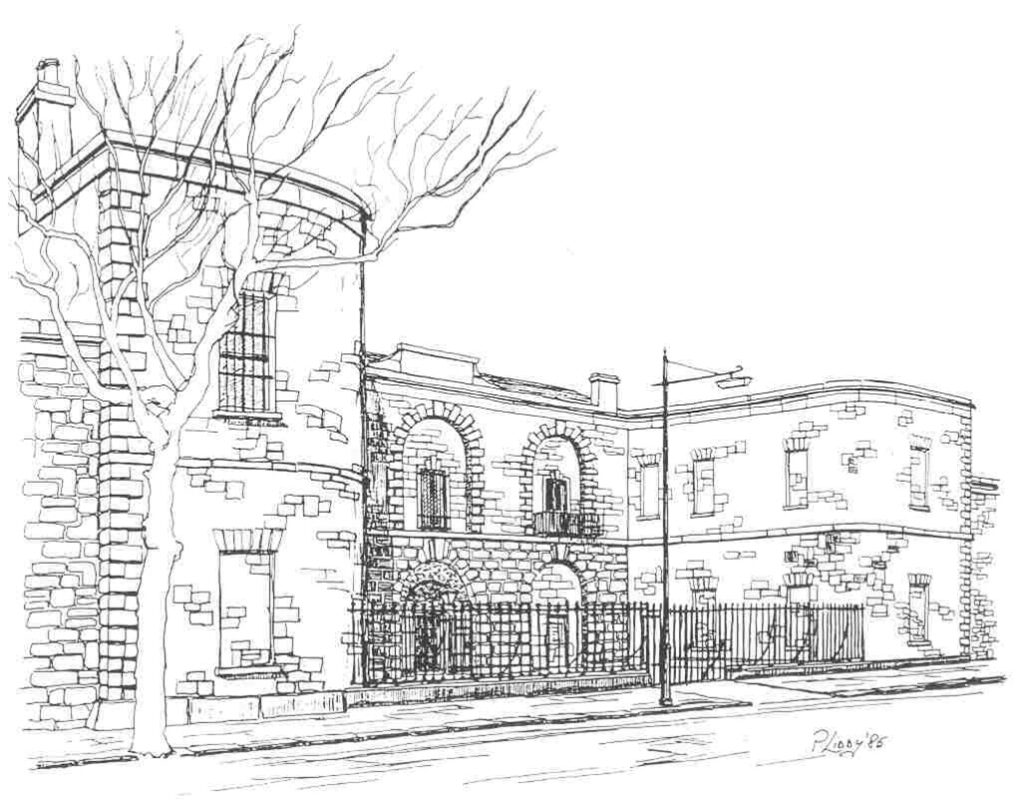
John McCurdy designed the Shelbourne Hotel but also designed another, less welcoming place of residence – the East Wing of Kilmainham Gaol in the 1840s. The original central section of the jail was designed by Scottish engineer and architect, John Trail and first opened in 1796. The site was known as Gallows Hill, where there was an earlier prison dating back to the 12th century which was originally known as the ‘Dismal House of Little Ease’. Its opening was partly inspired by the fear of French revolutionary ideals spreading to Ireland. This fear became a reality two years later in the Revolution of 1798. The participants of this insurrection soon filled the dank, solitary confinement and punishment cells. They were in turn followed by the rebels in the unsuccessful revolts of 1803, 1848 and 1867 and, more famously, by the leaders of the 1916 Easter Rising. The latter were taken here after their courts martial in nearby Richmond Barracks and were executed a short time later by firing squad in the stone-breakers yard.
The gaol didn’t just house revolutionaries; many ordinary criminals were imprisoned in Kilmainham. In the 1800s over 4000 prisoners were held here before being transported to Australia as convicts. Kilmainham Gaol itself was filled once more during the Irish Civil War of 1922/23. The last prisoner to be kept here when this conflict ended was future Taoiseach, Eamon de Valera, who was released on 16 July 1924. The jail was then abandoned and fell into decay. Unbelievably, it was ex-prisoners and their families and friends who started to restore the jail in 1960 before handing the project over to the State for completion and the opening of the place as a national institution.
Website: https://www.kilmainhamgaolmuseum.ie/